TRIZ is a Russian acronym meaning “Theory of Inventive Problem Solving”.
Strictly speaking, TRIZ is not a method but a theory, founded on the statistical study of several million patents, which shows that:
Its application relies on databases: some derived from the statistical study of patents, others structuring the knowledge of industry and research.
This mechanism — and 25 years of practice — is what lets us deliver a ranked concept book in 3 to 5 days, where conventional approaches grope along for months.
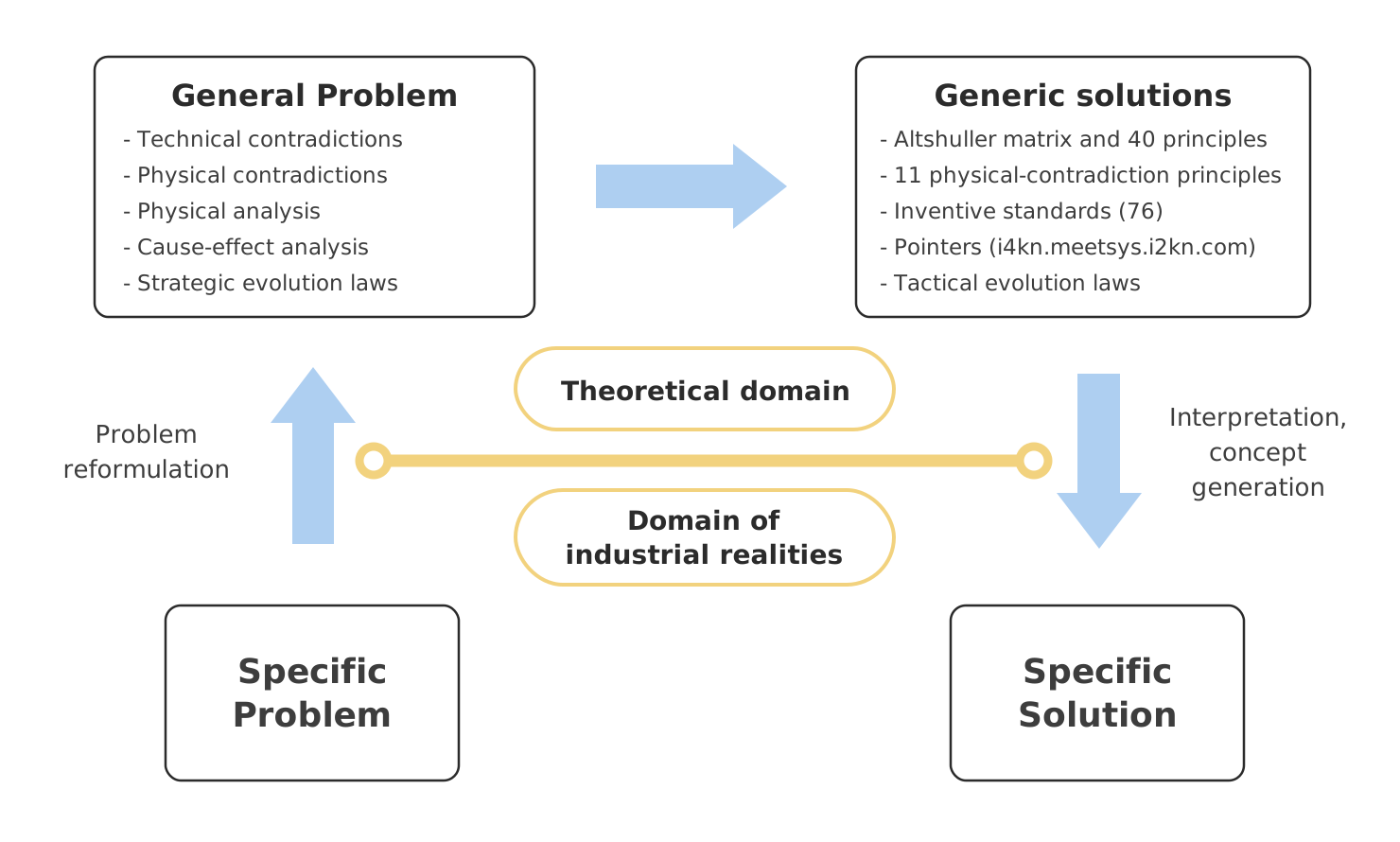
This process is the backbone of every one of our engagements — problem solving, innovation strategy or patent circumvention.
The notion of contradiction is central to the TRIZ approach. It describes the system through its fundamental physical parameters (temperature, shape, surface tension, etc.) and translates the problem either as an opposition between two of these parameters (technical contradiction), or as the need for a single parameter to take two different values (physical contradiction). These contradictions are resolved using the innovation principles, selected through the statistical ranking of the famous Altshuller matrix.
The term “vepole” comes from the contraction of two Russian words for substances and fields. Su-Field models represent a system as normalised functions (physical functions) expressing the work, in the thermodynamic sense, performed by its components. Identifying incomplete or harmful functions enables the use of Smirnov's algorithm and the inventive standards, which provide the statistical solutions to the problem; the database of physical and technical effects then helps find new ways to perform the failing function.
Navigating these models at scale — matrix, standards, effects database — is precisely what our TRIZ Wizard suite automates, while staying grounded in physics.
TRIZ was born in 1956 from the work of Genrich Altshuller, a patent engineer who systematically analysed hundreds of thousands of inventions to extract their regularities. Refined over forty years and then spread worldwide — the international association MATRIZ was founded in 1989 —, it is now taught at Stanford, MIT, Shanghai and other leading schools as “Modern TRIZ”, and applied every day in industry: more than 500 projects for TRIZ Conseil's clients alone.
The theory comes alive on a concrete case. Let's talk about yours.
Contact usor call +33 (0)6 22 06 93 28